Search is evolving beyond traditional Google results. Today, many people ask AI tools like ChatGPT, Gemini, and Perplexity to recommend businesses, services, and products. When someone asks for the “best dentist near me” or the “top roofing company in Dallas,” these AI engines analyze information across the web to decide which businesses to mention.
One of the most important signals they evaluate is Google reviews.
Ratings, review volume, recency, and what customers actually say about your business help AI systems determine which companies are trustworthy and worth recommending. In many cases, the same reputation signals that influence Google’s local rankings are now shaping AI-generated answers as well.
Understanding how to rank in ChatGPT increasingly comes down to managing your reputation—earning consistent reviews, maintaining strong ratings, and building trust signals that AI engines can recognize.
As Google shifts more local discovery into AI Overviews, your review profile now influences whether your business gets surfaced at all. In competitive local markets, Google increasingly treats reviews as discovery signals, not just reputation markers.
If you're trying to stand out in your city, recent, consistent review activity helps prove you're active, trusted, and relevant where customers already belong. Google reviews also benefit from high visibility in search results and Maps, making them especially influential in local discovery.
That matters because AI systems don't favor businesses with stale five-star profiles from years ago. They reward steady momentum. More than two-thirds of consumers prioritize recent reviews, and Google's ranking systems appear to do the same.
Reviews from the last 30 days carry outsized weight, while silence can weaken visibility. In most markets, maintaining at least 4-6 new reviews monthly supports baseline local presence, while 10-20+ helps you compete.
What Google Reviews Tell AI About Your Business
Reviews act like training data for local AI: they tell Google not just whether people like your business, but what you actually do, where you do it, and how consistently you deliver.
When customers mention “emergency plumber in North Austin” or “gluten-free bakery near downtown Denver,” AI learns your services, geography, and fit for local-intent searches.
It also reads sentiment and specificity. Detailed praise about fast installs, friendly staff, or accurate estimates helps AI categorize your business with more confidence than vague compliments. Google also uses this feedback to shape local pack rankings and broader search visibility. More positive reviews can also improve local SEO visibility, helping your business appear more prominently in nearby searches.
Recent reviews signal that you're active and still meeting expectations. If feedback turns mixed, AI may hesitate to recommend you.
Across Google, and niche directories, review language helps confirm your identity, location, and specialty.
That matters when similar businesses compete in the same ZIP code. Even your responses count: thoughtful replies to criticism show accountability, which strengthens trust signals and helps AI-generated summaries represent your business more accurately to nearby customers.
Why Google Review Volume Matters
While star ratings shape trust, review volume gives Google a measurable signal of local prominence. Prominence matters in local rankings because alongside relevance and distance, it is one of Google’s three main local ranking factors. In your neighborhood, that matters. Review quantity drives about 17% of local pack ranking factors and 26% of influence among top 10 local results.
Businesses in the 3-pack usually carry far more reviews than those sitting in positions four through ten. If you have 15 reviews while nearby competitors each have 100 plus, you're starting with a visible ranking deficit. Even a small base of five reviews can meaningfully increase customer action and strengthen your visibility.
You can't rely on old volume alone, though. Google weighs review velocity and recency, so five fresh reviews a week can outperform 50 reviews from two years ago. Consistent growth beats random spikes.
If your Google Business Profile is similar to another local business, stronger review signals usually decide who ranks higher. Volume also works best with quality: 200 reviews at 4.7 stars can beat 800 at 3.2.
And review content matters, because specific keywords strengthen your local relevance too.
How ChatGPT Uses Google Reviews
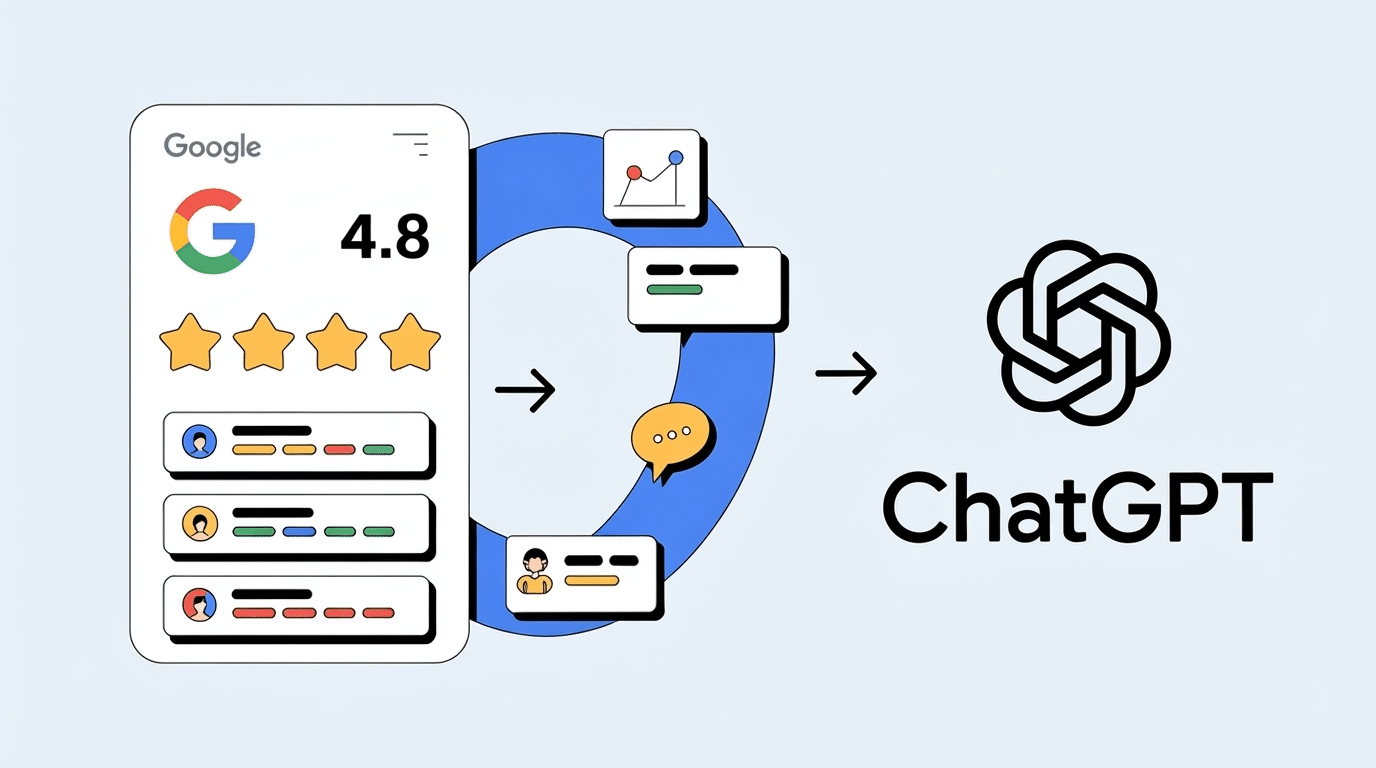
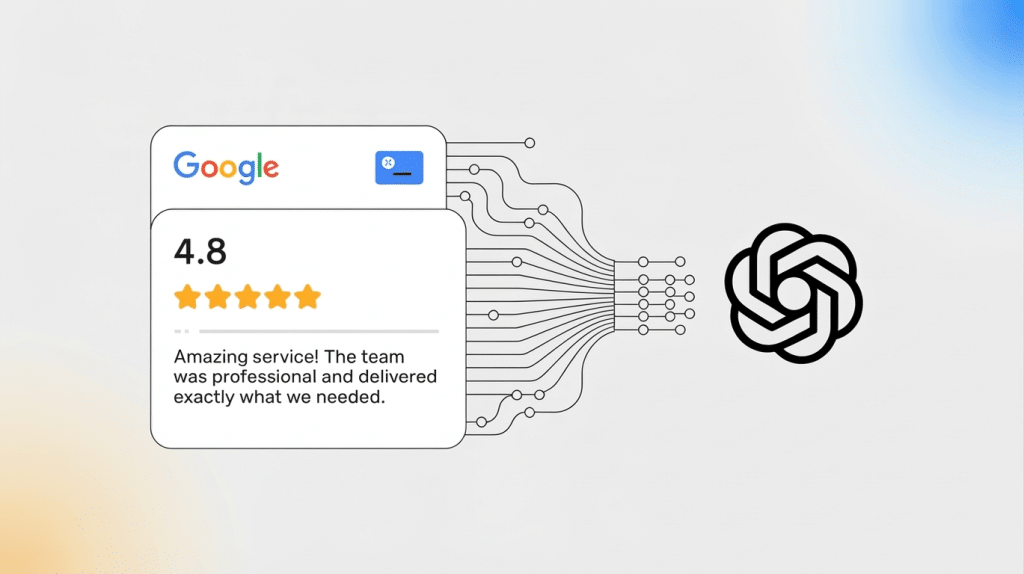
Google reviews are one of the strongest trust signals your business can build, but most local businesses don't realize how indirectly they reach AI search results. ChatGPT can't crawl your Google Business Profile the way a customer would. Star ratings, review counts, and Maps data are loaded through JavaScript, which makes them largely invisible to AI crawlers.
That doesn't make Google reviews irrelevant — far from it. It means the path they take to influence AI results is different than you'd expect. When your reviews get quoted, summarized, or referenced on crawlable third-party pages like Yelp, Trustpilot, Reddit, or niche directories, that's when ChatGPT can actually pick up on them. The review itself still matters. Where and how it surfaces across the web is what determines whether AI can see it.
This is why a strong Google review profile is really a foundation, not a finish line. Consistent ratings and sentiment across platforms strengthen what's known as entity coherence — the idea that when AI encounters the same trustworthy story about your business everywhere it looks, it's far more likely to cite you.
Whether you're a Dallas dentist, a Tampa roofer, or a Portland salon, the businesses earning AI visibility are the ones whose reputation carries across the entire web, not just one platform.
And freshness matters too. ChatGPT heavily favors recent content, so a steady flow of new reviews, mentioned and referenced across multiple sites, gives your business a compounding advantage over competitors who treat their review strategy as set-it-and-forget-it.
How Reviews Match Conversational AI Searches
People don't search ChatGPT the way they search Google. They ask it questions the way they'd ask a friend — "Who's the best Austin pediatrician for anxious kids?" or "Which Phoenix HVAC company actually shows up on time?" That conversational style is exactly why reviews have become one of the most powerful assets for AI search visibility.
Think about what a strong review actually contains. A parent describing how a pediatrician calmed their nervous child. A homeowner explaining that a roofer showed up when they said they would. That kind of language naturally mirrors the questions people are asking AI, which means review-rich pages often outperform keyword-optimized landing pages in conversational search results. When your Dallas dentist reviews or Tampa med spa testimonials echo the real questions and concerns your customers have, you're matching the dialogue patterns AI is already built to understand.
That alignment compounds quickly. AI doesn't just answer one question — it expands into related searches and cites the pages that keep surfacing across those results. Review pages that show up consistently across that process see dramatically higher citation odds, and a significant share of AI overview citations now come from pages that don't even rank in the traditional top ten. You don't have to outrank everyone on Google to earn a spot in ChatGPT's answers. You have to be the business AI keeps finding wherever it looks.
This is where the details in your reviews make a real difference. Specific experiences, timestamps, verified indicators, and clear comparisons give AI the kind of original data and semantic context it needs to confidently recommend you. Structured data like FAQPage and Article schema can further improve your chances of being cited. And beyond AI, Google reviews give potential customers publicly accessible proof of real experiences — building the kind of trust and credibility that reinforces your reputation both in search and in your community.
How to Optimize Google Reviews for AI
Optimizing your Google reviews for AI visibility comes down to three things: making them easy for language models to read, rich enough to provide real context, and consistent enough to build trust over time. The challenge is that most businesses know reviews matter but don't have a practical way to shape what customers actually write.
Start with the technical foundation. Use JSON-LD review schema so AI can pull ratings, reviewer details, and service context directly from your source code. Validate your markup with Google's Rich Results Test and include AggregateRating data that reinforces trust signals for your city, neighborhood, or service area.
Make sure your Google Business Profile is fully completed too — complete profiles see significantly more engagement, and accurate business information acts as another trust signal AI systems rely on.
The harder part is the reviews themselves. Detailed, natural reviews that mention your location, the problem a customer faced, the solution you provided, and what they valued most give AI far more to work with than a generic five-star rating. Conversational phrasing that mirrors how people in your market actually search makes those reviews even more effective.
But asking every customer to write that kind of review on their own is unrealistic — most people stare at the review prompt for ten seconds and type "Great service, highly recommend."
That's the problem Reviewly.ai was built to solve. When you connect your Google Business Profile to Reviewly.ai, the platform learns your niche, your market, and the specific services you offer. It then generates AI-suggested reviews for your customers that naturally incorporate the keywords and local context most likely to improve your visibility — both in traditional search and in AI results.
Your customers still leave authentic reviews in their own voice, but instead of starting from a blank page, they get a thoughtful starting point that's already optimized for how people actually search for businesses like yours.
You should also focus on consistency. Keep reviews coming every month, because fresh timestamps and steady velocity signal to AI that your business is active in the community right now. And don't chase perfect scores. A believable mix of ratings with specific, detailed sentiment helps AI read your profile as genuine, current, and locally trusted — which is exactly the kind of signal that earns citations.
How Better Reviews Improve Competitive Visibility
Once you’ve made your Google Reviews readable for AI, the next advantage is competitive visibility in your city and category. When someone asks ChatGPT for the best plumber in Phoenix or med spa in Austin, your review profile can move you ahead of nearby competitors. Strong sentiment, steady volume, and cross-platform consistency tell AI systems that local customers trust you, so your brand gets cited more often in direct answers and comparisons. Regular updates to your review profile signal content freshness, which can improve how often AI surfaces your business over less active competitors. Positive reviews also act as social proof, helping AI infer credibility and trustworthiness when comparing local businesses.
Review signal
AI visibility effect
Higher local ratings
More favorable competitor comparisons
Consistent recent reviews
Stronger citation frequency in AI answers
If your rivals have weaker sentiment or scattered feedback, you’ve got an opening. By tracking review gaps across Google, and niche sites, you can shape how AI describes your market position. Better reviews don't just boost reputation—they help you belong in the shortlist your community sees first, and be chosen more often.
Wrapping Up
AI search is changing how customers find local businesses, and Google reviews are at the center of that shift. They're no longer just social proof for people browsing your profile — they're the raw material AI uses to decide which businesses to recommend, cite, and trust.
The businesses that will win in this new landscape are the ones that treat their review strategy the way they treat their website: as something worth building intentionally. That means earning steady, detailed reviews that reflect how real people talk about your services. It means keeping your reputation consistent across every platform AI can access. And it means understanding that a five-star rating alone isn't enough — AI needs context, specificity, and freshness to confidently put your name in front of someone asking for help.
Reviews aren't applause. They're infrastructure. And the businesses that build that infrastructure now will be the ones AI keeps recommending long after their competitors realize they should have started sooner.
Share This Post On Social Media
Learn How AI Affects Local Businesses And Stay Ahead Of Your Competitors!
Enter Your Email Below For Our Weekly Insider Updates And Tips
About The Author
Jeff Schwerdt
Founder & CEO, Reviewly.ai
Jeff Schwerdt is the Founder & CEO of Reviewly.ai, a review management platform that helps businesses turn customer feedback into measurable growth. With over 10 years of experience in online reputation management, Jeff works with small and mid-sized businesses to build trust, improve local search visibility, and drive more revenue through smarter review strategies.
online reviews have the power to make or break your business reputation. With customers researching brands before they buy, review management is no longer optional—it’s essential. The right approach to collecting, monitoring, and responding to reviews not only builds trust but also drives real business growth. Whether you run a small local shop, a large […]
Did you know that 82% of consumers trust online reviews as much as personal recommendations? This is why positive Google reviews can be a game-changer for your business. We're about to explore the ultimate guide to securing these valuable testimonials. But this isn't just about getting any reviews; it's about getting the best ones. Why […]
Boost your Google ratings effortlessly with automated Google review requests. Increase customer feedback and enhance your online presence to drive more business today!
Seeking practical ways on how to get more Google reviews for your roofing company? Look no further. This article delivers straightforward, actionable steps to help you enhance your online presence and trust through sincere customer feedback. Discover how simple adjustments to your approach can lead to a significant increase in your Google review count. By […]
We are excited to announce our Q3 Feature Releases on Reviewly that will make managing your online reputation even easier and more effective. In response to many requests we have added WhatsApp Integration, Contact Record Data, Instant AI Google Review Draft Recommendations, 24 Hour Follow Up AI Assisted Google Review Draft Updates, and Multi Location […]
Discover how multi-location review management software helps businesses simplify reputation monitoring, automate responses, and improve local SEO across every branch. Learn the key features that scale—and why Reviewly.ai is a top choice for multi-location brands.