
Review Generation is about Keeping customers talking about your business. Building trust, but most companies fail to capture these powerful testimonials.

You have spent years building your business, delivering great service, and earning the trust of your customers. Then one morning you check your Google Business Profile and find a one-star review from someone you have never heard of, describing an experience that never happened. Welcome to the world of fake Google reviews. Whether they come from competitors trying to sabotage your reputation, disgruntled individuals with a personal grudge, or review farms selling fabricated ratings, fake reviews are a real and growing threat to businesses of all sizes.
The good news is that you are not powerless. In this guide, we will walk you through how to spot fake Google reviews, the step-by-step process for reporting them to Google, and the strategies you can put in place to protect your business and build a review profile that makes fraudulent attacks irrelevant.
You have spent years building your business, delivering great service, and earning the trust of your customers. Then one morning you check your Google Business Profile and find a one-star review from someone you have never heard of, describing an experience that never happened. Welcome to the world of fake Google reviews.
Whether they come from competitors trying to sabotage your reputation, disgruntled individuals with a personal grudge, or review farms selling fabricated ratings, fake reviews are a real and growing threat to businesses of all sizes. The good news is that you are not powerless. By learning how to identify fake reviews, report them effectively, and build a review strategy that makes your business resilient, you can protect the reputation you have worked so hard to build.
Fake Google reviews do not just hurt your feelings — they hurt your bottom line. A single fraudulent one-star review can drive potential customers straight to your competitors. Studies show that even a half-star drop in your average rating can reduce revenue by as much as nine percent.

Beyond the immediate financial impact, fake reviews erode the trust that legitimate customers place in your business. When prospective customers see negative reviews that do not match the experience of your actual clientele, confusion sets in.
They may second-guess their decision to visit you, call you, or buy from you. And because Google reviews directly influence your local search rankings, a cluster of fake negative reviews can push your business down in search results, reducing your visibility right when customers are looking for you.
The problem has become so widespread that the FTC issued a final rule banning fake reviews and testimonials in 2024, with civil penalties of up to $53,088 per violation. If you want to understand the full scope of how reviews affect your search presence, our article on how reviews impact SEO is a great place to start.
One of the clearest red flags is a reviewer profile with little to no activity. Click on the reviewer's name and look at their review history. If their only review is the one they left on your business — or if they have a handful of reviews all posted on the same day across unrelated businesses — you are likely looking at a fake account. Legitimate reviewers tend to have a mix of reviews across different businesses, posted at different times, with varying levels of detail.
Fake Google reviews are often vague by necessity. Because the person never actually visited your business, they cannot reference specific products, employees, dates, or experiences. Reviews that say things like "terrible service" or "worst place ever" without explaining what actually happened are classic indicators of fabricated feedback. Genuine negative reviews typically include details — a specific interaction, a product that failed, or a service that fell short of expectations.

Review farms often reuse the same text across multiple business listings. If a review on your profile uses a distinctive phrase, try searching that exact phrase in quotes on Google. If identical or nearly identical text appears on other businesses' review pages, you have strong evidence of a mass-produced fake review. This is particularly common with both fake positive reviews purchased by competitors for themselves and fake negative reviews planted against rival businesses.
A natural review pattern shows steady, gradual growth over time. If your business suddenly receives five or ten negative reviews within a few days — especially if your review history has been quiet — that spike is a major red flag. Coordinated review attacks often come in bursts because the person or service behind them is trying to inflict maximum damage in a short window. Pay attention to timing patterns and cross-reference with your actual customer traffic during those dates.
This one is a dead giveaway. If a reviewer complains about your dine-in service but you run a food truck, or they mention a product you have never carried, the review is almost certainly fake. Fraudulent reviewers sometimes target the wrong business entirely or use generic templates that do not match your actual offerings. These mismatches make it easier to build a case when reporting the review to Google.
Reviews that are entirely emotional outbursts — all caps, excessive exclamation marks, extreme language — without providing any factual basis for the complaint are often fake. While real customers can certainly be upset, they usually explain what went wrong. A review that reads like a rant with no actionable details is worth investigating further. For a broader understanding of how to read and interpret customer feedback, our post on sentiment analysis for reviews covers how to separate signal from noise.
Before you report anything, take screenshots of the fake review and the reviewer's profile page. Capture their review history, profile photo (or lack thereof), and the date the review was posted. Also check your own records — your CRM, booking system, POS, or email correspondence — to confirm that no customer by that name has ever done business with you. This documentation is critical for your report and for any potential escalation.
To report a fake Google review, navigate to the review on your Google Business Profile. Click the three-dot menu icon next to the review and select "Report review." Google will ask you to select a reason for the report. For fake reviews, the most appropriate option is typically "Spam" — described as a review from a bot, a fake account, or one containing ads and promotions. Submit the report and note the date you filed it.

Google typically reviews flagged content within three to seven business days, though there is no guaranteed timeline. If the review remains after a week, escalate through Google Business Profile support. When escalating, include your screenshots, a clear one-paragraph summary of why the review is fake, and any evidence from your customer records. Persistence matters here — some fake reviews require multiple reports before Google takes action. You can also report reviews through the Google Business Profile Help Center for additional support options.
While your report is pending, leave a calm, professional public response to the fake review. Something along the lines of: "We take all feedback seriously. However, we have no record of this visit in our system. We would love to discuss your concerns directly — please contact us at [phone number or email]." This response accomplishes two things. It signals to potential customers reading the review that you are attentive and professional. And it subtly highlights that the reviewer may not be a real customer, without being accusatory. How you respond to reviews — both real and fake — matters for your reputation. Our guide on review management covers best practices for crafting responses that protect your brand.
The conversation about fake Google reviews is not limited to fraudulent negative reviews. Fake positive reviews — whether purchased from review farms or generated by bots — are equally problematic and arguably more common. Some businesses buy five-star reviews to inflate their ratings, and while this might seem like a shortcut to success, it carries severe consequences. Google's detection algorithms have become increasingly sophisticated at identifying fake positive reviews.
Patterns like identical language across reviews, reviewers with no profile photos, reviews all posted from similar geographic locations, and unnatural rating distributions all trigger red flags. When Google catches fake positive reviews, it may remove them in bulk, penalize your listing, or even suspend your Google Business Profile entirely. The risk simply is not worth it. For a deeper dive into the ethical considerations of artificially generated reviews, our article on whether AI should write reviews explores the topic thoroughly.
The best defense against fake reviews is a robust collection of authentic ones. When your business has hundreds of genuine five-star reviews, a handful of fake negatives have minimal impact on your overall rating and are less likely to deter potential customers.
According to BrightLocal's 2026 Local Consumer Review Survey, 97% of consumers read reviews before choosing a local business, so a strong authentic review profile is your best shield. Focus on making it easy for every satisfied customer to leave a review — through QR codes, follow-up emails, and review request cards. A consistent stream of real reviews also makes fake ones easier for both Google and your customers to identify. Check out our guide on getting positive Google reviews for proven strategies to build your review volume.
You cannot respond to what you do not see. Real-time review monitoring ensures that you catch fake reviews the moment they are posted, giving you the fastest possible response time. Platforms like Reviewly.ai provide instant notifications whenever a new review appears on your Google Business Profile, so you can assess, respond, and report without delay. The faster you act on a fake review, the less damage it can do.
Managing your reviews manually across multiple platforms is time-consuming and leaves room for fake reviews to slip through unnoticed. A dedicated review management platform centralizes your monitoring, response, and reporting workflows into a single dashboard.
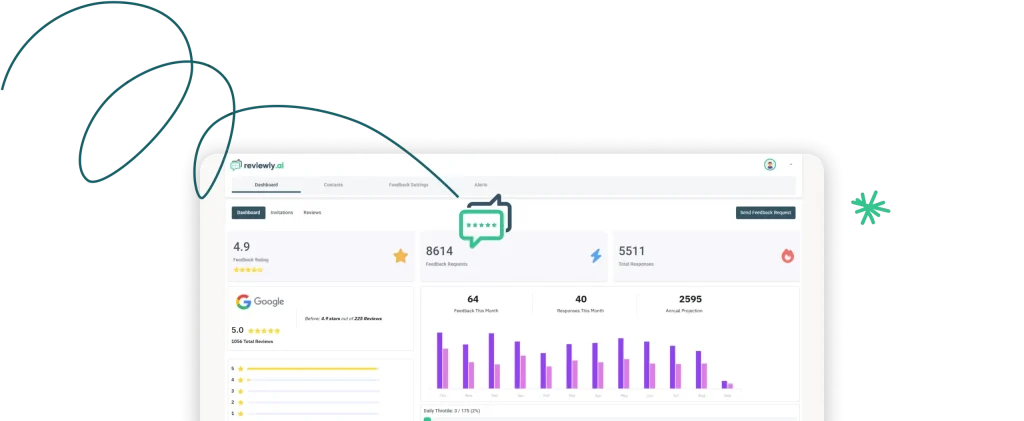
Reviewly.ai, for example, combines AI-powered response suggestions, sentiment analysis, and multi-platform monitoring so you can manage your entire reputation efficiently. If you are evaluating your options, our comparison of the best Google review management software can help you choose the right tool for your business.
Make sure your staff knows what fake reviews look like and understands the process for flagging them internally. The faster a fake review is identified, the faster it can be reported. Create a simple checklist based on the red flags outlined above — no reviewer history, vague language, recycled text, sudden clusters, and mismatched service descriptions — and share it with anyone on your team who monitors reviews.
In extreme cases, fake Google reviews can cross the line into defamation. If a fabricated review contains false statements of fact that damage your business reputation, you may have legal recourse. Some businesses have successfully obtained court orders requiring Google to remove defamatory reviews and identify the individuals behind fake accounts. However, legal action should be a last resort. It is expensive, time-consuming, and the outcome is never guaranteed.
In most cases, the combination of reporting through Google, responding professionally, and burying fake reviews under a mountain of authentic positive ones is the more practical and effective approach. If you are dealing with a sustained review attack and considering your options, consulting with a business attorney who specializes in online defamation is a reasonable step. The FTC's Endorsement Guides also outline the regulatory framework around fake reviews and endorsements.
Google has significantly ramped up its efforts to combat fake Google reviews in recent years. Their systems now use machine learning to detect patterns associated with fake reviews — including unusual posting behaviors, suspicious account activity, and content that matches known spam templates. Google removes millions of fake reviews annually and has implemented stricter penalties for businesses caught buying or soliciting fake reviews.
Their prohibited and restricted content policies outline exactly what types of reviews violate their guidelines and are subject to removal. In addition to algorithmic detection, Google has introduced features like anonymous reviews that change the review landscape. Understanding these shifts is important for any business managing its online reputation. Our article on anonymous Google reviews explains how these changes affect your business and what you can do to adapt.
How you respond to fake reviews says more about your business than the fake review itself. The worst thing you can do is respond emotionally, accuse the reviewer of lying, or ignore the review entirely. Instead, keep your response short, professional, and factual. Acknowledge the review, state that you have no record of the described experience, and invite the reviewer to contact you directly to resolve any concerns.
This approach demonstrates to every potential customer reading that review that you take feedback seriously and handle conflict with grace. It also creates a paper trail that supports your case when reporting the review to Google.
For businesses juggling multiple locations and review profiles, maintaining this level of professionalism across every response can be challenging. That is where AI-powered response tools — like those offered by Reviewly.ai — make a real difference, helping you craft appropriate responses quickly and consistently.
Fake Google reviews are an unfortunate reality of doing business in the digital age, but they do not have to define your reputation. By learning to spot the telltale signs — vague language, empty profiles, sudden clusters, and recycled text — you can identify fraudulent reviews quickly.
By following Google's reporting process and responding professionally, you can mitigate their impact while your report is reviewed. And by building a strong foundation of authentic reviews through consistent collection efforts and professional review management, you can make your business virtually immune to the damage fake reviews are designed to cause.
The businesses that thrive are not the ones that never receive a fake review. They are the ones that handle it with professionalism, protect their reputation proactively, and make it so easy for real customers to leave genuine feedback that the fakes become background noise. Start building that system today, and your reputation will speak for itself.
Jeff Schwerdt is the Founder & CEO of Reviewly.ai, a review management platform that helps businesses turn customer feedback into measurable growth. With over 10 years of experience in online reputation management, Jeff works with small and mid-sized businesses to build trust, improve local search visibility, and drive more revenue through smarter review strategies.

Review Generation is about Keeping customers talking about your business. Building trust, but most companies fail to capture these powerful testimonials.
Learning how to reply to a negative review is about more than damage control—it’s about restoring trust, and proving that you care about your customers’ experiences. Done right, even a bad review can become your best marketing moment.
Social media has emerged as a potent tool for businesses to connect with their audience, amplify their brand message, and drive growth. However, not all businesses harness its power effectively. In this blog, we'll uncover four common business mistakes owners often make with their social media accounts and provide insightful alternatives to pave the way […]
Find out how AI is transforming review management and why businesses still handling feedback manually are losing customers every single day.
Learn the top seven tactics to optimize your Google Business Profile for local SEO and improve your online visibility dramatically.
Boost your business's success in the digital age; dive into this comprehensive blog to discover why Google Reviews matter more than you think.