
Find out how 37 essential online review statistics for businesses in 2024 could revolutionize your reputation management strategy.
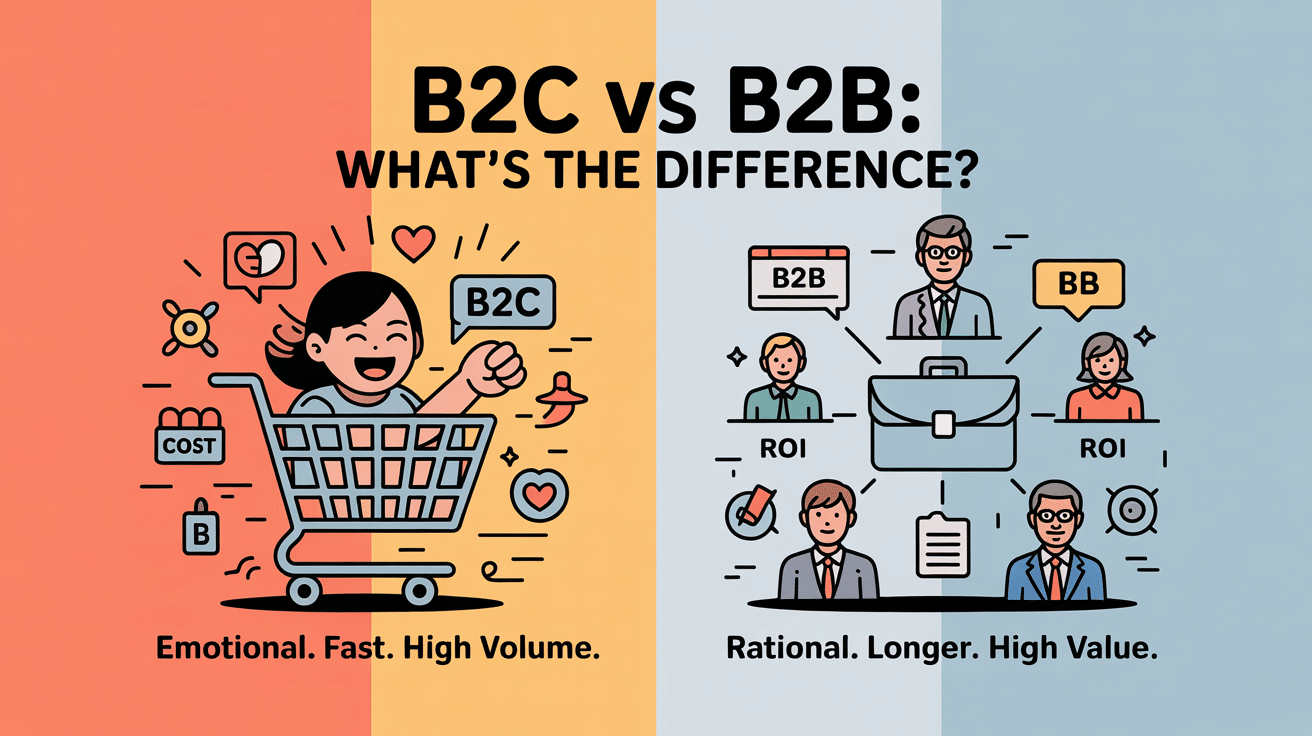
You've likely encountered both B2C and B2B business models in your daily life without recognizing their fundamental differences. When you buy groceries, you're engaging in a B2C transaction, but when your company purchases software licenses, that's B2B at work. These distinct approaches shape everything from marketing strategies to customer relationships, influencing how businesses communicate with you and what they prioritize in their sales process. Understanding these differences between B2C Vs B2B can transform your perspective on business interactions.
When examining the fundamental differences between B2B and B2C marketing, the target audience and decision-making process stand out as critical distinguishing factors.
While you're targeting businesses with B2B strategies, you're focusing on a smaller, more specialized audience of professional decision-makers like executives and procurement officers. Your messaging must appeal to multiple stakeholders who make methodical, logic-driven decisions based on ROI and business value.
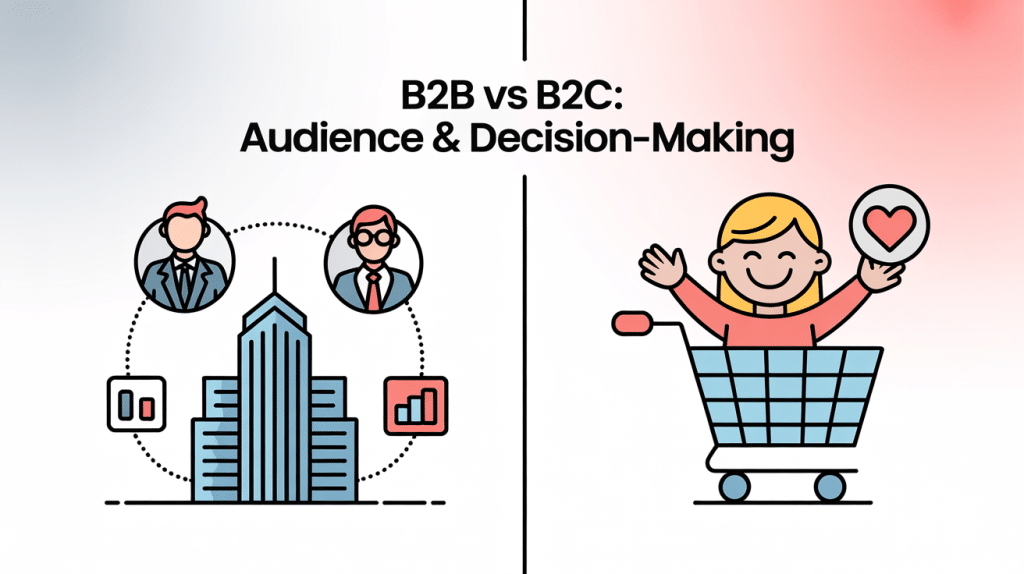
In contrast, B2C marketing casts a wider net across diverse demographics. You're connecting with individual consumers who typically make quicker, more emotionally-driven purchase decisions. These buyers don't need multiple approvals or extensive research—they're looking for products that align with their personal preferences and values.
Understanding these differences helps you craft the right approach. For B2B, you'll need account-based strategies and detailed content that demonstrates tangible benefits. B2B marketing often employs extensive research techniques since decisions involve multiple stakeholders and careful consideration of business implications.
For B2C, emotional appeal and aspirational messaging will better resonate with your audience. Additionally, B2C businesses should prioritize gathering and responding to customer reviews, as 73% of consumers consider Google reviews when making purchasing decisions.
The stark contrast in decision-making processes between B2B and B2C directly impacts another key distinction: the sales cycle timeline and purchasing complexity.
When you're selling to businesses, prepare for a marathon. B2B sales cycles typically stretch 2-8 months, with median durations of 2.1 months that can extend much longer for complex solutions. For effective outcomes, the sales cycle should ideally be completed within 30 days for maximum efficiency.
You'll navigate multiple stakeholders—on average, seven decision-makers in mid-sized companies—each with unique priorities and approval requirements.
In contrast, your B2C sales cycles feel like sprints, often completing within minutes or days. Individual consumers make quick, sometimes impulsive decisions without needing committee approvals.
They respond to emotional triggers and can self-serve through product-led funnels without extensive sales support. This consumer behavior mirrors how online reviews significantly influence purchasing decisions, with 93% of customers basing their choices on digital word-of-mouth.
This fundamental difference shapes your entire sales approach. For B2B, you'll need relationship-building strategies spanning months, while B2C requires creating frictionless experiences that capitalize on shorter decision windows.
Marketing approaches between B2B and B2C diverge considerably, reflecting their fundamentally different audience dynamics and decision-making processes.
When you're marketing to consumers, you'll focus on emotional triggers, visual storytelling, and creating desire through aspirational messaging that appeals to gut feelings and impulses. Smart agencies employ personalization at scale to tailor consumer-facing content to individual preferences, significantly boosting engagement rates.
In contrast, your B2B strategy must emphasize rational value propositions, data-driven case studies, and ROI-focused content that addresses multiple stakeholders in a longer decision journey.
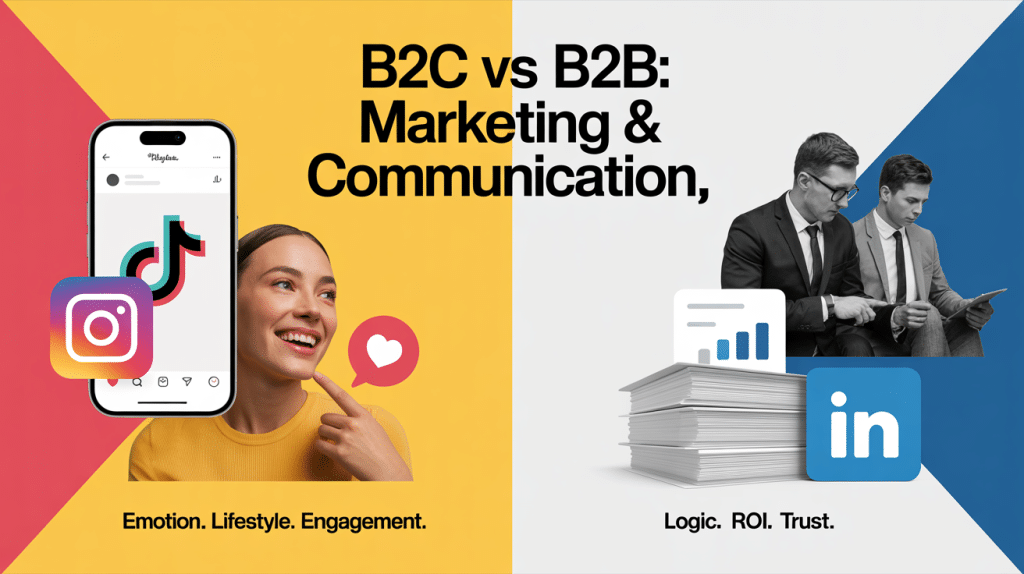
You'll communicate differently too—B2C thrives on platforms like Instagram and TikTok with entertaining, short-form content, while B2B demands LinkedIn presence, whitepapers, and technical documentation that builds trust through expertise.
Your tone matters equally: B2C messaging works best when it's engaging and promises lifestyle enhancement, whereas B2B requires a more professional approach centered on solving business problems and demonstrating industry credibility.
These distinctions help you connect authentically with your intended audience. Understanding these differences becomes even more crucial when managing hybrid models that serve both individual consumers and organizational clients simultaneously.
Customer relationships form the backbone of business success, though they manifest quite differently across B2B and B2C environments.
In B2B, you're building long-term partnerships based on trust and consistency, often managing fewer accounts with higher individual value. Your CRM focuses on nurturing these relationships over months or years through dedicated account management. B2B CRMs excel at account-based marketing and maintaining detailed records of complex organizational structures.

In contrast, your B2C relationships tend to be more transactional and emotionally driven. You'll manage a larger customer base with lower individual transaction values, emphasizing personalized experiences that encourage quick decisions. The effectiveness of these relationships is evident as 93% of consumers rely on online reviews before making purchasing decisions.
While B2B requires tracking multiple stakeholders and complex organizational hierarchies, B2C thrives on individual engagement and efficient service.
Your approach to customer service reflects these differences too—B2B demands in-depth, personalized support to maintain loyalty, while B2C can effectively leverage automation like chatbots alongside personalization.
While both B2B and B2C businesses rely on data-driven strategies, their approaches to gathering and analyzing information differ considerably.
You'll find B2B companies focusing on enriching their data with industry profiles, decision-maker identification, and technographic insights about what technologies potential clients use.
When it comes to methodology, you're likely to see B2B teams employing qualitative approaches like in-depth interviews and expert consultations, often using multiple research tools in combination.
They target smaller, specialized samples requiring high levels of expertise.
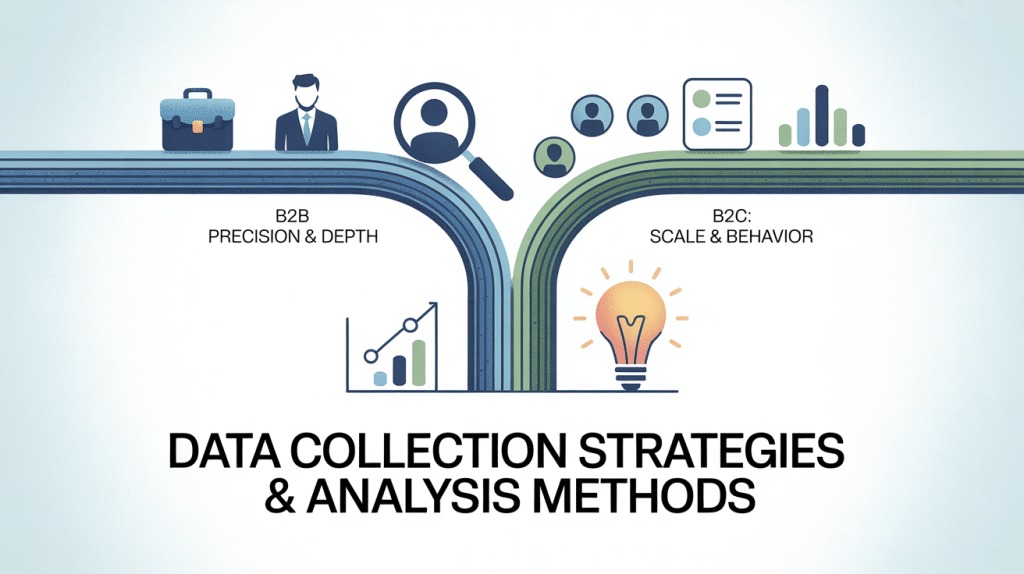
In contrast, you'll notice B2C research embraces large-scale quantitative methods including online surveys and social media monitoring. B2C data enrichment heavily relies on understanding consumer behavior to create personalized marketing campaigns and improve customer satisfaction.
They can tap into larger consumer panels and diverse sample sizes.
These differences reflect the underlying decision-making processes: B2B's complex, multi-stakeholder approach versus B2C's more emotional, individual-focused decisions.
For B2C companies, review management tools can significantly enhance data collection by aggregating customer feedback across multiple platforms into a single dashboard.
Your research design should account for these fundamental distinctions to gather truly actionable insights.
Although both B2B and B2C models generate revenue, their financial structures differ dramatically in transaction values, profit margins, and long-term stability. When you're selecting which model fits your business vision, understanding these fundamental differences helps you position for sustainable growth.
Whether you're swimming in B2C's fast-paced consumer waters or steering through B2B's complex corporate seas, understanding your audience is essential. While B2C thrives on emotional connections and quick conversions, B2B demands relationship building and value-driven approaches. Both strategies require tailored marketing, appropriate channels, and targeted data analysis. By recognizing these fundamental differences, you'll position your business for success in either marketplace.
Find out how 37 essential online review statistics for businesses in 2024 could revolutionize your reputation management strategy.
Get ready to discover the top 5 best social media crisis management strategies that can save your brand's reputation and keep your audience loyal.
Leverage top white-label SMS tools to scale review generation and client communication while protecting margins and compliance—but which platforms actually deliver?
Discover six crucial secrets for nurturing your digital marketing agency's growth and scalability; delve in and unlock your agency's full potential.
Gain insights into the intriguing world of AI-generated reviews and learn more about what is a AI review.
Kickstart your local business growth with the power of positive reviews; discover the five key ways they boost visibility, credibility, and sales.