
Boost guest satisfaction by mastering Review Management Practices For Hotels And Restaurants —discover key strategies for turning feedback into success.

I wrote this for businesses weighing TrueReview against the other options, and for the ones already on it who have hit a limit and are deciding what to move to. Below are the eight best TrueReview alternatives in 2026, compared on what they actually cost, how they collect reviews, what real users rate them, and which kind of business each one fits.
Every price here was checked against the vendor's own pricing page before publishing. Where a vendor does not publish a price, I say so rather than repeating a figure from someone else's blog. One thing I want to be upfront about: TrueReview is not an expensive product, and this is not a page about finding something cheaper. Its entry plan is $49 per month. Reviewly.ai starts at $99. If price alone is your deciding factor, TrueReview is hard to beat and you should probably stay. What follows is the case on substance.
The best TrueReview alternative depends on which limit you hit. Most people leave over one of four things: needing SMS without stepping up a tier, needing more than one location on a normal plan, wanting native integrations instead of routing everything through Zapier, or wanting a full communication platform rather than a review tool.
TrueReview rates 4.8 out of 5 from 72 reviews on G2 and 5.0 from 155 reviews on Capterra. Those are strong numbers, and the reasons people move are rarely about the software being bad. In my reading of those reviews and of TrueReview's own published plans, four patterns come up.
SMS is not on the entry plan. This is the one that catches most people. TrueReview's Starter plan at $49 per month is email only. Text message review requests begin on the Small Business plan at $99 per month, which is the same monthly price as Reviewly.ai. So the gap between us is not really $49 against $99. At the tier where you actually get SMS, you are comparing $99 against $99, and the question becomes which product does more with that channel.
One business per account below the top tier. Reviewers mention it directly: you "can only use 1 business under the same business account" until you reach Premium at $299 per month, which includes five locations. If you run two locations, the step up is steep for what you get.
Zapier does a lot of the heavy lifting. TrueReview has native integrations with Square, Google Contacts, Google Sheets, Acuity Scheduling and ServiceTitan, plus an API. Everything else runs through Zapier, which means another subscription, another thing to maintain, and another place for a broken connection to silently stop your review requests.
Deliverability and request caps. Some reviewers report messages being filtered as spam, and others find the caps tight, with one noting that "250 reviews a month is kinda low." The Starter plan includes 250 monthly requests and Small Business includes 500. If you serve more customers than that, you are either upgrading or leaving requests unsent.
None of that makes TrueReview a weak product. It makes it a product with a clear shape, and when your business grows past that shape, the switch is worth costing out.
This is the section most alternatives pages skip, which is why most of them read like ads. Here are the criteria I applied to every tool on this list, our own included.
Reviewly.ai is listed first because it meets all six, and because against TrueReview the comparison is close enough to argue feature by feature. It is also our product, which you should weigh accordingly. Everything in every other card is sourced so you can check my work.
| Tool | Best for | Starting price | SMS included at | Rating |
|---|---|---|---|---|
| TrueReview | Budget review automation | $49 per month | $99 per month | 4.8 on G2, 72 reviews |
| Reviewly.ai | Google review growth over SMS | $99 per month | $99 per month | 4.9 on Google, 54 reviews |
| NiceJob | Home and field service | $75 per month | $75 per month | 4.8 on G2, 419 reviews |
| Birdeye | Multi-location and enterprise | Custom quote | Quote based | 4.7 on G2, 4,242 reviews |
| Podium | One inbox for every channel | Custom quote | Quote based | 4.5 on G2, 2,100+ reviews |
| GatherUp | Agencies and multi-location | $99 per month | $99 per month | 4.5 on G2, 50 reviews |
| Broadly | Reviews plus AI receptionist | $399 per month | $699 per month | 4.7 on G2, 75 reviews |
| HiFiveStar | Lowest cost to start | Free, paid from $28 | $28 per month | Not listed on G2 or Capterra |
| Trophy Jar | Trigger-based requests | $9 per month | $9 per month | Not listed on G2 or Capterra |
Starting price tells you almost nothing about the channel most of these tools are actually sold on, so this is the table I would look at first. The detail that surprised me while researching this page is what TrueReview's $99 Small Business plan actually sends. According to TrueReview's own SMS page, that tier sends one text message followed by a three-step email series. Multi-step SMS sequences begin on the Premium plan at $299 per month. The same page states that texting works in the United States and Canada.
| Tool | SMS starts at | Text sequence depth | Sending number | Reach |
|---|---|---|---|---|
| TrueReview | $99 per month | 1 text plus a 3-step email series, multi-step SMS at $299 | Carrier-verified US or Canada number | US and Canada |
| Reviewly.ai | $99 per month | SMS sequence with automated reminders | Dedicated number per account | 100+ countries |
| NiceJob | $75 per month | SMS and email follow-ups on a day 1, 3 and 7 schedule | Not published | Not published |
| Birdeye | Quote based | Not published | Not published | Not published |
| Podium | Quote based | Not published | Not published | Not published |
| GatherUp | $99 per month | Up to 300 SMS credits per location each month | Not published | Not published |
| Broadly | $699 per month | Not published | Not published | Not published |
| HiFiveStar | $28 per month | Requests and automatic reminders by text, email or WhatsApp | Not published | Not published |
| Trophy Jar | $9 per month | Unlimited requests and follow-up sequences | Not published | Not published |
The number of "not published" entries in that table is the point. Sequence depth, sending number and country coverage are the three things that decide whether a review program works, and most vendors leave all three off the pricing page. Put them in writing before you sign anything, and ask specifically whether your texts go out from a number assigned to your business or from a pool shared with other customers.
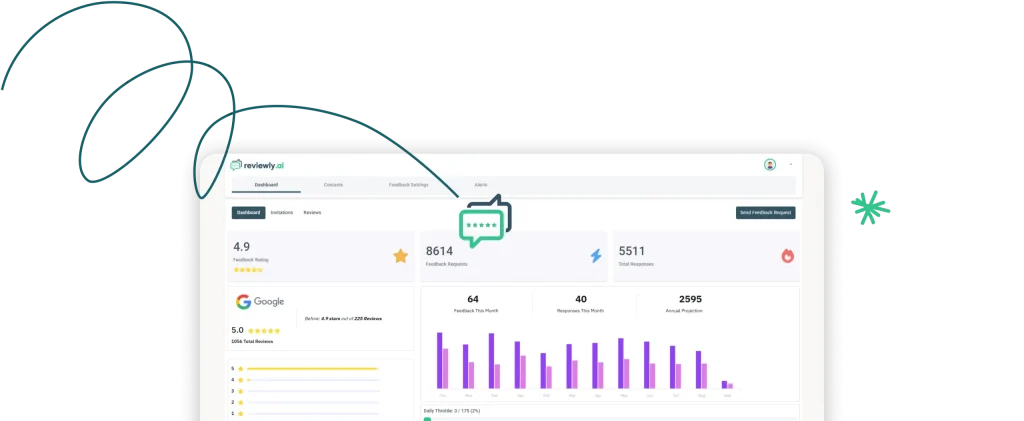
Reviewly.ai does one job and builds everything around it: getting more real Google reviews from customers you already served, and making the replies fast enough that you actually send them. Against TrueReview the comparison is close, and it comes down to what each product treats as the main event. TrueReview is a review automation tool where SMS is a tier upgrade. We are an SMS-first tool where the text message is the product, and the offline capture, the AI drafts and the reply-by-text flow all exist to support it.
| Pros | Cons |
|---|---|
| SMS is the core product, not a tier upgrade | No email request channel, SMS only |
| Offline capture through QR, NFC and Review Plates | Thin third-party review profile so far |
| Reply to reviews by text without logging in | Built around Google, not every review site |
If you want the wider market view before deciding, we broke the category down by cost in our guide to reputation management pricing.
NiceJob calls what it does reputation marketing rather than reputation management, and the product follows through. It collects reviews, then puts them to work through social proof widgets on your site, automatic social sharing and referral prompts. For a contractor, cleaner or landscaper whose next job comes from someone seeing the last one, that loop matters more than another dashboard.

| Pros | Cons |
|---|---|
| Strong public rating and clear published pricing | AI replies sit on the higher tier |
| Turns reviews into website and social proof | Website add-on carries a setup fee |
| Free trial with no card required | Not built for multi-location rollouts |
Birdeye is the heaviest product on this list. Reviews, listings, social, surveys, webchat, appointment scheduling and customer experience analytics all live in one console, packaged in 2026 under AI assistants it calls Jay, Myna and Robin. If you are leaving TrueReview because you outgrew a review tool rather than because you disliked it, this is the end of that road.

| Pros | Cons |
|---|---|
| Deepest feature set and largest review base | No published pricing to compare |
| Built for scale across many locations | Heavier than a single-location business needs |
| Listings and social included | Longer sales and onboarding cycle |
We compared this one in more depth on its own page if you are weighing it seriously: Birdeye alternatives.
Podium consolidates texts, calls, webchat, social messages and reviews into a single shared inbox, with an AI assistant that drafts review invites and responses. It is the option to look at if your team is drowning in channels rather than short on reviews. It is also the most expensive way on this list to solve a review problem, because reviews are one module of a communication platform.

| Pros | Cons |
|---|---|
| Genuinely useful if channels are your problem | No published pricing at all |
| Large and well established review base | Reviewers report annual lock-in and add-on fees |
| Strong POS and CRM trigger coverage | Expensive way to buy review automation alone |
If this is the direction you are leaning, we covered the full field in our breakdown of Podium alternatives.
GatherUp has been in local reputation longer than most of this list, and it shows in how the pricing is built. Instead of gating locations behind tiers, it charges per location at a flat rate, which makes budgeting for a five or fifteen location rollout a single multiplication rather than a negotiation. It is also the option agencies tend to land on when they want white label without buying a whole marketing platform.

| Pros | Cons |
|---|---|
| Per-location pricing scales predictably | Smaller public review base than the majors |
| SMS and email credits on every plan | Agency tier requires a quote |
| Deep monitoring across 100+ sites | Listings cost extra per location |
Broadly is not really a review tool with extras, it is a marketing and front-office service with reviews inside it. You get an AI chat receptionist, a CRM, local search tracking, directory syncing and social posting, and on the higher tiers an AI phone receptionist that books appointments. For a home service business with no marketing staff, that bundle is the pitch. For anyone who just wants review requests to go out, it is a lot of money.

| Pros | Cons |
|---|---|
| Published pricing and month-to-month terms | By far the highest entry price here |
| AI receptionist captures leads you would miss | $350 onboarding fee on the main plans |
| Reviews, SEO and social in one bill | Automatic review requests only on Premium |
HiFiveStar is the only tool here with a genuinely free tier, and its paid ladder is built around location count rather than feature gates. If you are leaving TrueReview to spend less and you accept that you are buying a narrower product, this is the honest answer to that question.

| Pros | Cons |
|---|---|
| Real free tier and the lowest paid SMS entry | No public ratings to verify against |
| Fully published pricing ladder by location | Shallower automation than TrueReview |
| No contracts or setup fees | Branding stays until the $197 tier |
Trophy Jar does one narrow thing well. It watches the systems you already use and fires a review request the moment a deal closes or an invoice is paid. If your problem is not which tool to buy but simply never getting around to asking, the trigger model solves it for less than most people spend on coffee.

| Pros | Cons |
|---|---|
| Lowest price on this list by a wide margin | Newest and least proven product here |
| Unlimited requests and integrations on both plans | No ratings on the major review platforms |
| Triggers remove the human bottleneck | Narrow scope, requests and widgets only |
Put the feature lists aside. The right answer falls out of four questions, and you can work through all of them in about ten minutes.
Open your TrueReview account and look at what stopped you. If it was SMS being locked behind the $99 tier, you are comparing $99 products and you should pick on channel depth. If it was the one-business-per-account restriction, you want per-location pricing, which points at GatherUp or HiFiveStar. If it was Zapier breaking, you want native integrations. If it was nothing in particular and you were just curious, stay where you are.
This is where monthly prices stop being comparable. TrueReview includes one location until the $299 Premium plan, then charges $39 per add-on location. GatherUp charges $60 per location from two upwards. HiFiveStar sells 3 locations at $85 and 10 at $139. Reviewly.ai prices per location with an enterprise tier above that. Work out your cost at your real location count before you compare anything, because the ranking changes completely between one site and ten.
Be honest about which channel actually works for your customers. Text requests get opened and acted on faster, which is why most of these tools lead with them, but a business with a long B2B sales cycle and no mobile numbers on file may genuinely need email. TrueReview, NiceJob, GatherUp and HiFiveStar do both. Reviewly.ai is SMS only by design, and if email requests are essential to your process, that is a real reason to pick something else from this list.
Before you move, list the systems that currently trigger your requests. If it is Square or ServiceTitan you have native options almost anywhere. If you built something custom through Zapier, check whether your shortlist has a native connector, because rebuilding that wiring is usually the longest part of a switch.
The thing that keeps people on a tool they have outgrown is usually the switch itself. Here is what it really takes.
Your reviews stay exactly where they are. Every Google review lives on your Google Business Profile, not inside TrueReview. Cancelling does not remove a single one and your star rating does not move. Changing review software has no effect on the reviews you already earned.
Export your customer list before you cancel. Contacts, request history and any templates you want to keep should come out while you still have access. Put a reminder in your calendar for a week before renewal.
Budget a few days for 10DLC registration. Any tool sending business SMS in the United States has to register your brand and campaign with the carriers. It is routine, and it is the single most common reason a switch feels slower than expected. Start it on day one.
Rebuild your triggers, not just your templates. Copying the wording across takes minutes. Reconnecting the system that decides when a request goes out takes longer, and it is what determines whether the new tool actually outperforms the old one.
Run both for two weeks if you can. Most of these tools offer a 14-day trial. Sending from the new tool while the old one is still live is the only way to compare delivery and response rates on your own customers rather than on a vendor's case study. We walk through the timing side of that in our guide to automated Google review requests, and the ranking side in how reviews affect Google rankings.
Yes, for a single-location business that mainly needs email review requests and basic monitoring, TrueReview is one of the better-value options available. It rates 4.8 out of 5 from 72 reviews on G2 and 5.0 from 155 on Capterra, and its Starter plan is $49 per month. The two places small businesses outgrow it are SMS, which does not appear until the $99 tier, and locations, since the base plans cover a single business.
TrueReview is review management software that requests, monitors and helps you respond to customer reviews. It collects reviews by sending review requests over SMS and email, either one at a time, in bulk from a CSV import, or automatically through drip campaigns triggered by a customer action. It monitors incoming reviews across major sites, drafts AI responses, tags reviews by sentiment, and includes a Review Radar feature that flags Google reviews that may breach policy. Integrations include Square, Google Contacts, Google Sheets, Acuity Scheduling and ServiceTitan natively, with everything else routed through Zapier or its API.
TrueReview publishes three plans. Starter is $49 per month, or $29 per month billed annually at $348, and covers 250 monthly requests by email only for one location. Small Business is $99 per month, or $59 annually at $708, and adds SMS plus 500 monthly requests. Premium is $299 per month, or $179 annually at $2,148, and covers 2,500 requests across five locations with unlimited campaigns and team members. Extra locations are $39 per month each. There is a 14-day free trial that includes up to 250 requests.
Four reasons come up most often. SMS requests are not available on the $49 entry plan, so anyone who wants texting is already paying $99. The lower plans cover a single business, so adding a second location means jumping to the $299 tier. Most integrations beyond the five native ones run through Zapier, which adds cost and a point of failure. And some users report request caps being tight and messages being filtered as spam. None of these are deal breakers for a single-location business sending a modest volume, which is why TrueReview still rates so well.
Yes. HiFiveStar has a forever free plan for one location, and its paid plans start at $28 per month with SMS included, which is cheaper than the TrueReview tier where SMS begins. Trophy Jar starts at $9 per month for the first two months and $29 after that. Both are narrower products than TrueReview, so you are trading automation depth for cost. Neither is listed on G2 or Capterra yet, so there is no independent rating to check them against.
For two to ten locations, GatherUp at $60 per month per location is the most predictable, and HiFiveStar is cheaper still if you need less depth. For large multi-location brands and franchises, Birdeye is the most complete platform. Compare at your real location count, because TrueReview's own multi-location path means the $299 Premium plan plus $39 per additional site.
No. Your reviews live on Google, Facebook and the other platforms where customers left them, not inside the software. Cancelling ends your ability to send requests and manage replies from that dashboard, and you lose the historical request data held there, which is why exporting before you cancel matters.
You do not strictly need it, but it is the channel most of these tools are built around for a reason: a text gets opened and acted on while the customer still remembers the visit. Email still works where you have no mobile numbers or a longer sales cycle. The more useful question is whether your tool charges extra for the channel your customers actually respond to.
The honest summary of this page is that TrueReview is a good product with a specific shape, and most people who leave it do so because they outgrew that shape rather than because something went wrong. If you are a single location sending email requests, staying put is a perfectly reasonable decision and I would rather tell you that than pretend otherwise.
If you do move, compare at the tier you would actually buy. A $49 plan that does not include the channel you need is not a $49 plan. Once you line up the tier that gives you SMS, the number of locations you really run, and whether your integrations survive the move, the shortlist usually narrows to two.
Reviewly.ai is in that shortlist when the job is Google review volume over SMS. We send the requests, draft the replies with AI so responding takes seconds, capture walk-in customers through QR codes and NFC, and show you what is working in a dashboard you will actually open. If that is the job you are trying to get done, you can run it on your own customers before you pay anything.
Book a 1-on-1 demo with our team and we will look at your current review flow, show you what switching would involve, and give you a straight answer about whether we are the right fit. If you want to read first, start with our overview of google review management software and our guide to review management services.
Jeff Schwerdt is the Founder & CEO of Reviewly.ai, a review management platform that helps businesses turn customer feedback into measurable growth. With over 10 years of experience in online reputation management, Jeff works with small and mid-sized businesses to build trust, improve local search visibility, and drive more revenue through smarter review strategies.

Boost guest satisfaction by mastering Review Management Practices For Hotels And Restaurants —discover key strategies for turning feedback into success.
Trust has become the currency that drives consumer decisions. For small businesses, establishing and nurturing trust is paramount. This is when Reviewly steps in, a powerful ally that empowers small businesses to generate authentic customer reviews and engage meaningfully with customers. In this short but insightful blog, we'll explore the significance of constantly generating reviews, […]
Key factors for selecting a white label software provider will surprise you; can you afford to miss these critical insights?
Are you struggling with stagnant growth in your digital marketing agency; Discover five potential culprits and how to kickstart your growth again.
Google reviews decide who ranks, who's trusted, and who gets the click. See why they matter in 2026 and how to turn ratings into more customers.
For a car dealership, trust is the whole game. A buyer is about to make one of the largest purchases of their life, and before they ever set foot on your lot, they’re reading what other people said about you on Google. In fact, 76% of car buyers use online reviews as a primary source […]