You might feel reviews are just noise, but in 2026 they decide who shows up, who’s trusted, and who gets the click. You rely on Google for discovery, and your customers do too. High star ratings, recent feedback, and thoughtful responses now shape credibility, conversions, and local SEO. They influence how algorithms rank you, how customers perceive you, and even how investors evaluate your growth potential. Ignore them and competitors outrank you; manage them and revenue grows. The difference isn’t luck—it’s repeatable. Let's dive into the importance of google reviews and how to make Google reviews work like a growth engine.
Google reviews are important because they directly shape three things every business depends on: whether you rank in local search, whether customers trust you, and how much revenue you earn. They are today's word-of-mouth at scale - 83% of consumers read reviews on Google before choosing a local business. Manage them well and you compound visibility, trust, and sales;
How Important Are Google Reviews for a Business?
Google reviews influence a business in four measurable ways:
Boosts local SEO and visibility - Review signals account for roughly 16% of Google Local Pack ranking factors, one of the largest categories after your Business Profile itself. Volume, recency, and steady velocity lift your position in Maps and the local 3-pack.
Builds credibility and social proof - 92% of consumers choose businesses rated 4 stars or higher, making a 4.0+ average the practical threshold for being considered at all. Reviews are public proof of how you treat customers before anyone contacts you.
Drives revenue and conversions - Each additional star in your average rating drives a 5-9% increase in revenue, according to a Harvard Business School study by Michael Luca. Systematic review collection is also associated with a 15-20% lift in conversion rates.
Provides business intelligence - Reviews are a continuous feedback stream. Sentiment and recurring themes tell you exactly what to fix in your product, staffing, or process - and 59% of consumers expect a business to respond within 24 hours.
Why Do Google Reviews Matter So Much?
Google reviews carry outsized weight because Google is where discovery actually happens.
Google Search handles roughly 90% of the search market, and Google hosts about 57-58% of all online reviews, so your rating shows up on Search results, Maps, and the local 3-pack whether you manage it or not.
Reviews are now embedded even deeper into the buying journey. AI-powered summaries appear directly under business listings, distilling thousands of reviews into quick highlights like "great service" or "slow delivery." Customers form an opinion from that snapshot before they ever open your profile - which means your reviews are effectively the first impression, and they are impossible to avoid on mobile search.
Do You Need a Perfect Five-Star Rating?
No - and a perfect rating can actually work against you. Trust peaks when your average sits between 4.2 and 4.5 stars; a flawless 5.0 with no critical feedback reads as fake to shoppers who have learned to distrust spotless profiles. What matters more than perfection:
Recency. For 73% of consumers, reviews older than 30 days don't count. A steady flow of fresh reviews signals an active, legitimate business.
Volume and detail. Written, specific reviews build more trust than a bare star average, and local leaders average roughly 240 reviews.
How you handle the negatives. A handful of honest critical reviews you've responded to well builds more credibility than silence. That said, more than four unanswered negative reviews can turn away about 70% of potential customers - so respond, don't ignore.
The goal isn't a perfect score. It's a believable, current, well-managed one.
How Reviews Drive Consumer Behavior and Purchase Decisions
The process of discovery leads to the final result through reviews because most consumers need multiple trustworthy reviews before making a purchase and they always begin by searching on Google.
You are in good company since 95% of consumers check reviews before making a purchase and 91% of them consult reviews while making their final decision. Most of us need a base of proof: 75% read at least four reviews, and 81% check Google before visiting a business. In fact, 59% expect a response from businesses within 24 hours, underscoring how speed and engagement influence trust and selection.
Positive signals convert. Positive customer reviews create a feedback loop that drives more customers to select products or services because 72% of customers purchase after reading positive reviews and 93% of customers decide to buy based on review content.
Companies which take control of their review management experience a 15–20% increase in conversion rates. These reviews function as vital resources which help customers decide on their purchases.
Money follows individuals who have proven themselves trustworthy. Businesses with solid reputations can raise their prices because customers will spend more money when they see positive Google reviews which results in a 31% increase in spending at the "excellent" review level. A single one-star review will result in a 5-9% increase in revenue.
You also expect reciprocity. You probably want to do business with companies that respond to customers since 97% of people check for replies and 56% choose brands that answer back and 92% will think twice before contacting a brand that does not respond.
The Impact of Ratings and Recency on Trust and Credibility
Because credibility hinges on both the score you see and how fresh it is, ratings and recency shape whether you trust a business at all. You're not alone: 88% lean on Google reviews before buying, and most of us feel safer when the average lands between 4.2 and 4.5 stars. In fact, 92% choose businesses with at least 4 stars, while 55% ignore anything below that. Volume and detail matter too—95% trust brands with more reviews, and 88% trust written feedback over bare stars. Reviews also influence visibility, with reviews impact local SEO by contributing roughly 10% to local ranking factors and lifting conversion rates by 15–20%.
You also look for freshness. For 73% of people, reviews older than 30 days don't count, and 83% say recency is non-negotiable. Ongoing, authentic reviews help your community spot legitimacy and avoid outliers. Businesses with authentic experiences typically generate more trust than those with merely high ratings.
Trust Signal
Credibility Insight
Star average
4.2–4.5 feels most trustworthy
Recency
New reviews within 30 days sustain confidence
Authenticity
Many detailed, non-AI reviews build belonging
Still, more than four negative reviews can turn away about 70% of potential customers.
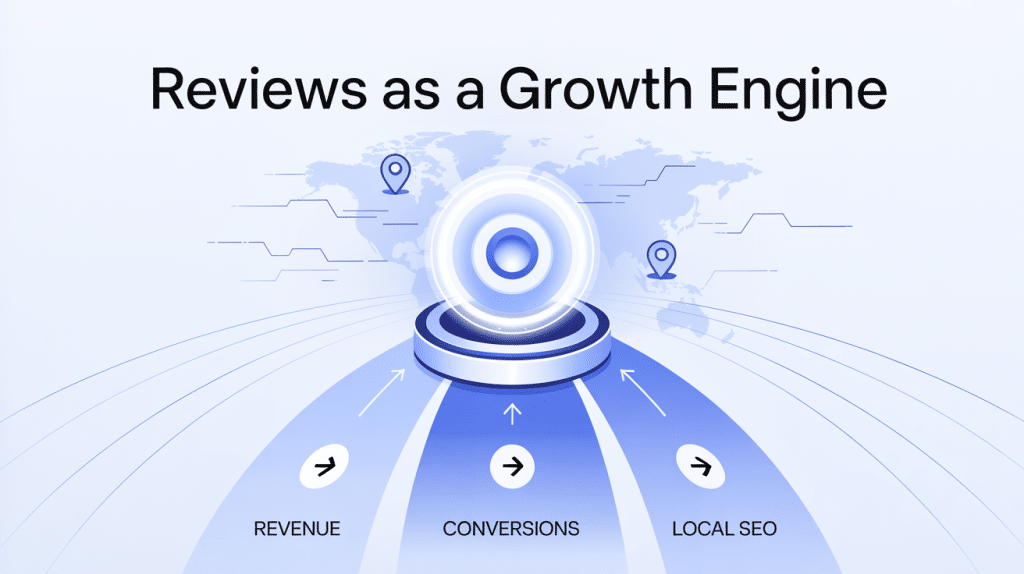
Reviews as a Growth Engine: Revenue, Conversions, and Local SEO
Star ratings affect trust levels but Google reviews generate business growth through revenue production and conversion rate optimization and better local search visibility. When your profile shines, customers feel like they've found "their" place—and they spend more.
Businesses that get higher ratings will earn 37% more annual revenue and will get 5–9% revenue growth for each additional star they receive. The product receives "excellent" reviews which leads customers to pay prices that are 31% higher. Businesses with more than 200 reviews generate 82% higher revenue and review management excellence leads to an 18% revenue boost for companies. The 57.5% of online reviews that come from Google make it essential to focus on building reviews for your Google Business Profile because this is where customers already search for businesses.
Reviews also convert. Since 95% read reviews and 83% check Google before buying, your review page is the real storefront. The systematic collection methods lead to a 15–20% increase in conversion rates yet customers who give ratings between 1 and 2 stars only interact with the content at a 13% rate. Verified business profiles enable companies to build trust with customers which results in improved visibility within the Local Pack results that customers view.
Reviews function as a continuous cycle which drives continuous growth. The more customers you serve and engage with, the more reviews you collect. Your business will achieve higher local search positions through positive reviews which will drive more website traffic. The review process creates a self-reinforcing cycle which transforms basic review methods into a long-term system for natural business expansion.
Organizations that perform review collection on a scheduled basis instead of treating it as a single event achieve continuous enhancements to their online presence. Businesses that ask for weekly reviews get twice as much local search traffic than companies that ask for reviews at random times.
Reviews play a crucial role in enhancing the local search engine optimization of a business. Google hosts the majority of online reviews and weighs them at roughly 16% of Google Local Pack ranking factors. Your local visibility will increase by 15–20% when you maintain positive volume and sentiment which leads to better positions in Maps and the local pack.
The Future of Reviews in 2026 and Beyond
Reviews now serve as active trust indicators which distribute across multiple platforms. Google will use AI to evaluate reviewer credibility and emotional tone in addition to star ratings when making recommendations in 2026. Verified profiles and photo reviews and location-based authenticity markers will affect how rankings are determined.
AI-generated content will spread more widely in the future yet human authenticity will stay the essential factor. The upcoming Google algorithms will give preference to contextual credibility which places genuine experiences above numerous positive reviews. Organizations that collect genuine feedback from multiple sources will boost their search engine rankings and build long-term customer trust.
Reviews will integrate better with other trust indicators which include website references and social media opinions and customer feedback. Forward-thinking brands will establish a single feedback system which unites all available data to generate continuous intelligence that benefits marketing operations and service improvement and product development.
Best Practices for Managing Google Reviews
Reviews only compound when you work them on a schedule instead of treating collection as a one-time event. Keep your Google Business Profile accurate, ask consistently, respond to everything, and defend against fakes. The table below maps each strategy to the single action that matters most:
Strategy
Actionable Step
Encouraging reviews
Send an automated follow-up (SMS) with a direct review link immediately after a transaction
Responding to positives
Reply by name, thank the customer, and mention a specific detail from their visit
Handling negatives
Apologize sincerely, clarify facts neutrally, and move complex conversations to a private channel
Sustaining velocity
Request reviews weekly - businesses that do earn about twice the local search traffic of those that ask sporadically
Fighting fake reviews
Use filters, report policy-violating patterns, and invite verified mobile users to leave feedback
For the full workflow - monitoring, response templates, and a review-generation system - see our guide on how to manage Google reviews. To automate it end to end, a purpose-built google review management software handles collection, alerts, and AI-assisted responses in one place.
How many Google reviews does a business need? There's no fixed minimum, but recency and volume both matter - local leaders average around 240 reviews, and consumers discount anything older than 30 days. Consistent weekly collection matters more than any single milestone.
What is a good Google review rating? A 4.2-4.5 average is the sweet spot for trust. Above 4.0 gets you considered; a suspiciously perfect 5.0 with no critical feedback can reduce credibility.
Do responses to reviews actually matter? Yes. A majority of consumers prefer businesses that reply, and replying to reviews measurably increases engagement and conversions. Unanswered negative reviews are the most damaging.
How do I deal with fake or unfair reviews? Flag reviews that violate Google's content policies through your Business Profile and track the dispute; use review filters and monitoring to catch patterns early. Google removes reviews that break its policies, though not ones that are simply negative.
Next Step
In 2026, Google reviews are your storefront’s neon sign—bright, public, and constantly judged. When you cultivate recent, high-star feedback and jump into conversations, you don’t just build trust—you fuel conversions, rank higher locally, and open the tap on revenue.
Google reviews reward businesses that manage them as a system, not a side task. Reviewly.ai runs that system for you - automated SMS review requests, AI-suggested responses, and one dashboard for monitoring and sentiment across every location. Connect your Google Business Profile in under 90 seconds and start turning reviews into ranking, trust, and revenue.
Share This Post On Social Media
Learn How AI Affects Local Businesses And Stay Ahead Of Your Competitors!
Enter Your Email Below For Our Weekly Insider Updates And Tips
Jeff Schwerdt is the Founder & CEO of Reviewly.ai, a review management platform that helps businesses turn customer feedback into measurable growth. With over 10 years of experience in online reputation management, Jeff works with small and mid-sized businesses to build trust, improve local search visibility, and drive more revenue through smarter review strategies.
Wondering how to remove a Google review that's dragging down your rating? You're not alone — it's one of the most common frustrations business owners face. The truth is, Google doesn't hand you a delete button just because a review is unfair or inaccurate. But that doesn't mean you're completely powerless. There are legitimate ways […]
Embarking on the journey of managing Google Reviews can seem daunting for a beginner in 2024—but fear not! In this beginner’s guide to Google Reviews, you’ll be armed with everything you need to claim your Google Business Profile, gather impactful reviews, and navigate customer feedback like a pro. Whether it’s your first step into the […]
Leverage top white-label SMS tools to scale review generation and client communication while protecting margins and compliance—but which platforms actually deliver?
Creating a Google Business Profile (GBP) is essential for any business looking to enhance its online presence. However, not all businesses have a physical address. This guide will walk you through the process of how to create a Google Business Profile without needing a physical business address, ensuring you can still take advantage of this […]